The house
that Wally built.
A thirteen-year-old from Barbados, a taxi fare that changed everything, and a room on Massachusetts Avenue that has refused — for nearly eighty years — to go dark.
1910 · Ellis Island ● 1947 · Paradise Opens ● 1979 · The Move ● Today · Four Generations
Thirteen years old, one suitcase.
Before there was a club, there was a kid on a boat — and a city that had no idea what he was about to give it.
Joseph L. Walcott emigrated from Barbados in 1910, passing through Ellis Island at age thirteen and joining his brothers in Boston. He worked whatever the city offered — and eventually built a small taxi business, saving every dollar toward something bigger.
In the fall of 1945, one of his fares was James Michael Curley, the once-and-future mayor of Boston, campaigning for re-election. Curley promised that if he won, he’d help Walcott secure a liquor license — something no Black man in Boston had ever been granted. Curley won. He kept his word. By late 1946, the license was approved.
On New Year’s Day 1947, Wally’s Paradise opened at 428 Massachusetts Avenue — the first nightclub in New England owned by a Black man, opened in an era of segregation so that Black Bostonians would finally have a room of their own.
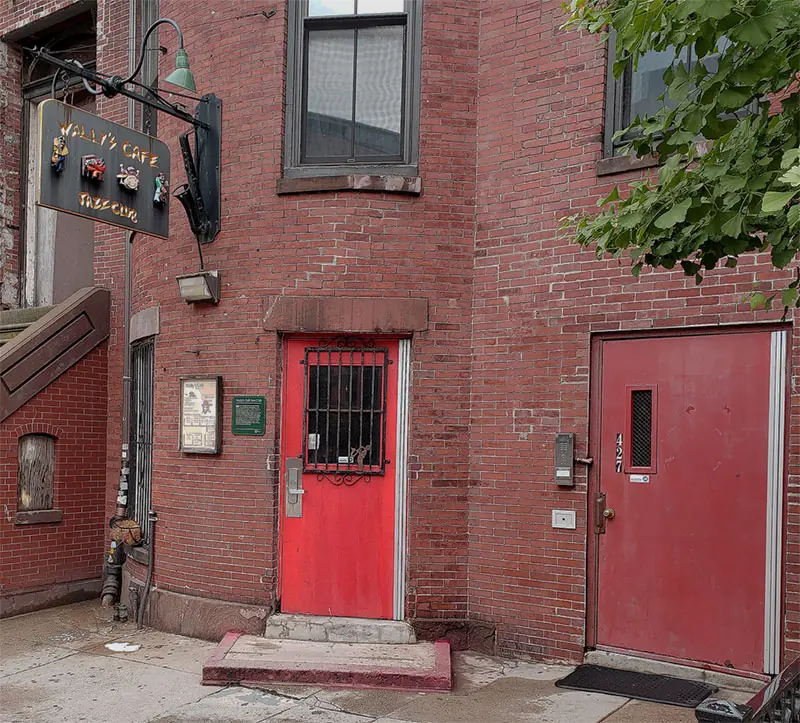
No. 427 Mass Ave · The Red Door — South End, Boston
Across the street, and into history.
When the Big Band era faded in the sixties, Wally made the decision that would define the club forever: he handed the bandstand to students from Berklee, the Boston Conservatory, and the New England Conservatory, seating them beside seasoned veterans of the touring years. The kids got a stage. The audience got the future, three feet away.
In 1979 the club crossed Massachusetts Avenue, from No. 428 to the narrow room at No. 427 it still calls home — behind a small black sign and a red door that regulars will tell you is the most important door in Boston music.
The crossing
Thirteen-year-old Joseph L. Walcott arrives at Ellis Island from Barbados and settles in Boston, where his brothers had landed a few years earlier.
The fare
Campaigning politician James Michael Curley steps into Walcott’s cab and promises to help him win a liquor license. Curley wins; the license follows in 1946.
Paradise opens
On January 1st, Wally’s Paradise opens at 428 Massachusetts Avenue — the first Black-owned nightclub in New England, in a city still divided by segregation.
The greats come through
Charlie Parker, Duke Ellington, Cannonball Adderley, and Lou Donaldson all play the room, and the South End becomes a required stop on the jazz map.
The pivot
As the Big Band era wanes, Wally hands the stage to conservatory students, mixing them with veterans — the apprenticeship model that still runs nightly.
The move
The club crosses the street to No. 427 — the long, narrow room behind the red door where the music has lived ever since.
Wally's century
Joseph Walcott passes at 101 years old. His daughter Elynor and his grandsons — Paul, Frank, and Lloyd Poindexter — take up the keys and keep the door open.
Four generations, still swinging
Live music every night of the year. The same family, the same mission, the same room — and a line that still forms on Mass Ave before the first downbeat.
Next — 03